
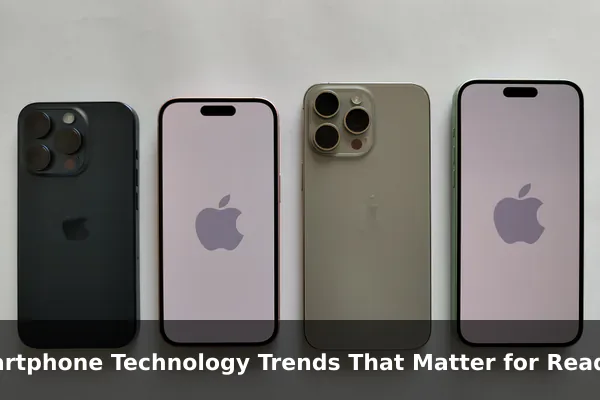
Smartphone innovation in the current cycle is less about a single headline feature and more about how artificial intelligence, networks, software support, cameras, batteries, and ecosystems quietly work together. The phone you carry today is the product of dozens of overlapping trends, and only a few of them genuinely change how you use the device every day. The rest tend to be marketing language that fades within a release cycle or two.
This guide breaks down the smartphone technology trends that matter for readers right now, separating the practical from the promotional. We will lean on official platform documentation from Apple and Google, industry data from the GSMA and Ericsson, and market tracking from IDC where possible. Because device availability, operating system features, network coverage, and pricing can shift quickly, the tone here stays cautious: trends point in a direction, but specifics for your country, carrier, or device should always be verified against current official sources.
By the end, you should have a clearer sense of which trends deserve weight in your next upgrade decision, which ones are easy to ignore, and how to think about value across a phone’s full life cycle rather than just its launch-day spec sheet.
AI Is Moving From Cloud Features to On-Device Help
The most visible smartphone trend right now is the shift of artificial intelligence from distant data centers to the chip in your pocket. Modern flagships and many mid-range devices ship with dedicated neural processing units that can run language models, image generation, and voice features locally. Apple describes this direction broadly under Apple Intelligence on its official iOS pages, while Google documents on-device AI capabilities in the Android platform documentation.
For everyday readers, this matters in three concrete ways.
Writing, Summarizing, and Translating
Phones can now draft replies, summarize long emails, rewrite messages in different tones, and translate conversations in near real time. Some of this still calls cloud services for heavier work, but more of the lightweight tasks run directly on the device. That can improve latency and, in many cases, privacy, since text never leaves the phone.
Photo and Video Editing
AI tools can remove objects, expand backgrounds, sharpen details, and reframe videos. The quality gap between manual editing and a quick AI pass is narrowing, especially for casual social posts. Results still vary by device, and on-device models are typically less capable than cloud equivalents.
Search, Assistants, and Accessibility
Assistants are becoming more context-aware, able to act on what is on screen, in your calendar, or in your recent messages. Accessibility features such as live captions, visual descriptions, and voice-controlled navigation also benefit. Availability is uneven, however: many AI features require a recent chip, a specific region, a particular language, or an account tier. Always check the device’s official feature page before assuming a capability is included.
5G Is Becoming Normal, but Coverage Still Matters
5G is no longer a premium talking point; it is the default radio in most new smartphones sold worldwide. The GSMA’s Mobile Economy reports and Ericsson’s Mobility Report both track rising 5G subscription numbers and continued growth in mobile data traffic. For most readers, the practical question has shifted from should I buy a 5G phone to how much does 5G actually help where I live and travel.
Speed, Latency, and Battery
In areas with mature mid-band 5G, downloads are faster and latency is lower, which helps with cloud gaming, video calls, and large app updates. Millimeter-wave 5G can be very fast but is typically limited to dense urban zones. Battery impact has improved across generations but can still be noticeable when signal is weak and the modem works harder to stay connected.
Coverage and Carrier Bands
Two phones with the same 5G label can behave very differently if they support different bands. Before buying, check which 5G bands your carrier uses and confirm the device supports them. This is especially important for imported phones or models sold across multiple regions.
- Look for mid-band 5G support, which often provides the best balance of speed and coverage.
- Verify VoLTE and VoNR support so calls work cleanly on modern networks.
- Treat peak speeds as marketing; typical speeds depend on tower load, distance, and band.
Software Support Is Now a Major Buying Factor
A few years ago, software updates were a footnote. Today they are arguably the most important long-term spec on a smartphone. Multiple Android manufacturers now promise several years of major OS upgrades and security patches, and Apple has long been known for extended iOS support on older iPhones. Google’s Android platform documentation outlines current platform direction and security expectations, while Apple’s iOS pages detail the ongoing feature roadmap.
Why Software Lifespan Matters
Long software support affects three things readers care about:
- Security: regular patches close vulnerabilities used by malware, phishing kits, and data-harvesting apps.
- Feature longevity: many newer features, especially AI tools, require recent OS versions.
- Resale value: phones with longer support windows hold value better on the second-hand market.
Privacy and Accessibility Improvements
Each platform release tends to tighten privacy controls, such as more granular location access, clearer permission prompts, and stricter background tracking limits. Accessibility additions, including better screen readers, hearing aid integration, and motor-control options, also arrive through software updates. A device that stops receiving updates loses access to these incremental improvements even if the hardware still works fine.
Camera Progress Is About Processing, Not Just Megapixels
Camera marketing still leans on big megapixel numbers, but real improvements increasingly come from the image signal processor, computational photography pipelines, and AI-assisted editing. Two phones with similar sensors can produce very different photos because of how their software interprets light, motion, and color.
Computational Photography in Plain Terms
When you tap the shutter, modern phones often capture a burst of frames at different exposures, align them, and blend them into one image. This is how night mode brightens dark scenes without blowing out highlights, and how portrait mode separates subjects from backgrounds. The same approach helps with motion freezing, HDR, and panorama stitching.
Video Is Catching Up Fast
Video features that were once limited to professional cameras, such as log color profiles, higher dynamic range capture, and advanced stabilization, are now common on flagships and trickling down to mid-range models. For casual creators, this means more flexibility in editing without needing extra gear.
How to Compare Cameras Sensibly
- Look at real sample images from reviewers shooting in conditions similar to yours.
- Check low-light and zoom samples, where weak cameras struggle most.
- Consider video stabilization and audio if you record clips often.
- Be cautious with spec-sheet comparisons; sensor size, lens quality, and processing matter more than the headline megapixel count.
Battery Life and Charging Are Getting Smarter
Battery technology is evolving slowly, but the surrounding ecosystem is improving quickly. Modern chips are more power-efficient, displays adapt their refresh rate to content, and operating systems use machine learning to predict and limit background activity. The result is that many current phones comfortably last a full day even with heavy use.
Charging Standards Worth Knowing
Wired fast charging has split into several standards, including USB Power Delivery with Programmable Power Supply and various proprietary protocols. Wireless charging continues to mature, with Qi-based standards remaining the most broadly compatible. Specific wattage claims vary widely, so always check official device pages for accurate figures.
Battery Health Tools
Both Android and iOS now expose battery health information and offer settings to limit charging to a lower maximum, which can slow long-term wear. Useful habits include:
- Avoid extreme heat, which accelerates battery aging more than charge cycles do.
- Use slower charging overnight when speed is not important.
- Keep the OS updated so adaptive battery features stay current.
Foldables and New Form Factors Are Still Niche but Improving
Foldable phones, flip phones, and large-screen hybrids have moved past the experimental phase but remain a relatively small share of the global market. Durability has improved through better hinges, tougher inner displays, and refined creases, although these designs still demand more care than traditional slab phones.
Who Benefits Most From Foldables
- Heavy multitaskers who want a tablet-sized canvas for documents, spreadsheets, or split-screen apps.
- Content creators who appreciate larger viewfinders and flexible camera angles.
- Users who prefer compact phones that unfold to a normal screen size when needed.
Tradeoffs to Weigh
Foldables generally cost more, weigh more, and may have shorter battery life than equivalent slab flagships. App support has improved but is still inconsistent for split-screen and resizable layouts. If you want a foldable, treat the first year of ownership as a learning period for both you and the device.
Privacy, Security, and Ecosystem Lock-In Are Reader-Level Issues
Privacy and security are no longer just IT-department concerns; they directly affect daily phone use. Modern platforms layer biometric authentication, granular permissions, encrypted messaging, and anti-tracking features into the OS itself. Both Apple’s iOS pages and Google’s Android documentation describe ongoing changes in these areas.
Practical Privacy Habits
- Audit app permissions regularly and revoke anything that does not need location, microphone, or contacts access.
- Enable platform anti-theft tools, such as Find My iPhone or Find My Device, before you ever need them.
- Use passkeys where possible to reduce reliance on reusable passwords.
- Keep backups encrypted and stored somewhere you control.
The Ecosystem Question
Each major platform encourages staying inside its ecosystem through messaging, payments, smartwatches, earbuds, and cloud storage. This integration is convenient but can make switching harder later. Before deepening your ecosystem commitment, consider how easy it is to export your data, whether your accessories will still work on another platform, and whether features you rely on are available across devices.
The Smartphone Market Is Recovering Unevenly
Market trackers such as IDC publish quarterly reports on smartphone shipments, vendor share, and regional trends. Recent cycles have shown uneven recovery: premium devices continue to perform well, replacement cycles in many regions have lengthened, and growth is increasingly driven by select emerging markets. The GSMA’s Mobile Economy data similarly highlights how mobile internet adoption and 5G uptake vary widely by region.
What This Means for Buyers
- Promotions are common on previous-generation flagships, which often remain excellent value.
- Mid-range competition is intense, with strong cameras, AMOLED displays, and competent chips at lower prices than a few years ago.
- Availability varies by region, so a model praised in one market may launch later, or never, in another.
Be Cautious With Numbers
Specific shipment figures, ranking positions, and growth percentages change with each quarter. When you see a precise market-share number quoted online, check the source and date before relying on it. Official tracker pages are updated regularly and are a safer anchor than secondhand summaries.
What These Trends Mean Before Your Next Upgrade
Pulling these trends together, the most useful smartphone today is rarely the one with the loudest spec sheet. It is the one that fits your daily use, lasts several years with full software support, and integrates cleanly with the services you already rely on.
A Practical Pre-Upgrade Checklist
- Software support window: confirm how many years of OS and security updates the device will receive.
- Battery health and charging: check capacity, charging speeds, and whether the OS exposes battery health tools.
- Camera fit: look at real samples in conditions you shoot in, not just marketing shots.
- Network compatibility: verify 5G bands, VoLTE, VoNR, and Wi-Fi standards for your carrier and home network.
- AI feature availability: confirm which AI tools are supported on the specific model in your region and language.
- Storage and RAM: pick configurations you can live with for the full ownership period, since most phones cannot be upgraded later.
- Repairability and accessories: check official repair options, parts availability, and whether your existing chargers and cases still apply.
- Total cost of ownership: include cases, screen protection, insurance, and possible battery replacement, not just the sticker price.
When to Skip an Upgrade
If your current phone still receives updates, holds a charge through your day, and runs the apps you need, the strongest move is often to wait. Replacing the battery, cleaning up storage, and resetting the device can extend its useful life by another year or more, which is both cheaper and gentler on the environment.
Conclusion
The smartphone trends worth paying attention to right now are the ones that quietly compound: on-device AI that saves time, mature 5G that improves real connections, longer software support that protects your investment, smarter cameras driven by processing, and batteries that age more gracefully thanks to better software. Form factors like foldables, deeper ecosystem ties, and shifting market dynamics shape the edges of the experience, but they rarely make or break a daily-driver phone on their own.
Use official sources, including Apple’s iOS pages, Android’s developer documentation, GSMA’s Mobile Economy data, Ericsson’s Mobility Report, and IDC’s smartphone tracker, to verify any specific claim before you act on it. Treat marketing language as a starting point, not a conclusion. With that approach, you can navigate today’s smartphone technology trends with confidence and pick a device that genuinely fits how you live, work, and stay connected.
Official references
- GSMA Mobile Economy – Authoritative global mobile industry data on 5G adoption, smartphone penetration, mobile internet use, AI, and ecosystem trends.
- IDC Smartphone Market Insights – Primary market-tracker source for current smartphone shipment volumes, vendor share, and quarterly market direction.
- Ericsson Mobility Report – Useful for current mobile network trends, 5G subscriptions, traffic growth, and connectivity forecasts affecting smartphones.
- Android Developers Android 16 Documentation – Official Android platform documentation for current OS features, performance, accessibility, privacy, and developer-facing changes.
- Apple iOS – Official Apple source for current iPhone software trends, iOS features, Apple Intelligence, privacy, and ecosystem direction.
