
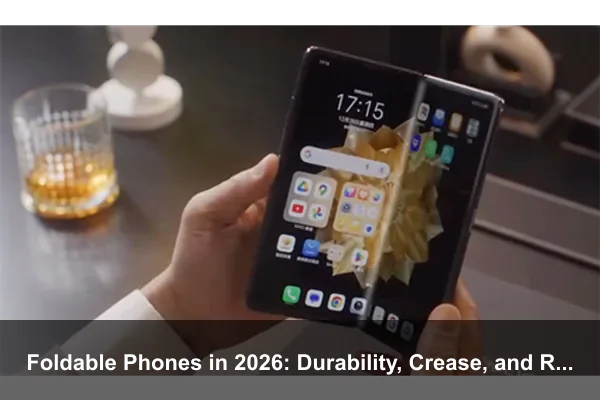
Introduction: Foldables Are No Longer Fragile Experiments
Foldable Phones in 2026: Durability, Crease, and Real-World Reliability is no longer a niche question for early adopters only. The category has moved from engineering showcase to everyday flagship alternative, with book-style foldables replacing small tablets for some users and flip-style foldables giving compact phones a second life. The reason shoppers still pause is not performance, camera quality, or software. Modern foldable phones are fast, bright, and capable. The real questions are more practical: Will the hinge stay smooth? Will the inner screen survive two or three years of use? How visible is the crease after months of folding? Can a foldable phone handle dust, rain, drops, pockets, travel, kids, and repair costs?
In 2026, the honest answer is more encouraging than it was a few years ago, but it is still nuanced. The best folding phones have stronger hinges, better ultra-thin glass layers, tougher frames, improved water resistance, and more mature software. Some models now advertise dust protection that earlier foldables could not claim. Google has promoted the Pixel 10 Pro Fold with an IP68 rating and a gearless hinge. Samsung’s Galaxy Z Fold7 highlights an Armor Aluminum frame, Armor FlexHinge, IP48 protection, and tougher cover glass. Honor, OPPO, and Motorola have pushed hard on thinness, hinge materials, water protection, and crease reduction. These are meaningful gains, not just marketing upgrades.
At the same time, a foldable is still not the same object as a traditional slab phone. The inner display must bend, which means it uses a layered flexible structure rather than a single sheet of rigid glass. The hinge creates moving gaps and mechanical tolerances. The crease is reduced, not magically erased. Reliability depends on how the phone is carried, cleaned, opened, dropped, repaired, and insured. This guide explains what durability actually means for foldable phones in 2026, how to judge crease visibility, which specifications matter, and what real-world reliability looks like after the honeymoon period ends.
The State of Foldable Phone Durability in 2026
The foldable phone market has matured because manufacturers finally understand that thinness alone does not win trust. Early foldables made people nervous because reviewers and buyers saw screen protector issues, hinge gaps, debris problems, and visible creases. By 2026, the competition is different. A premium foldable is expected to have a reinforced frame, a sophisticated hinge, an inner display stack designed for impact absorption, and at least some kind of water or dust rating. Buyers are also more informed. They know that a beautiful unfolded screen matters less if the phone spends half its life being handled with anxiety.
Better Materials, Better Engineering
Modern foldable durability is built from several parts working together. The frame has to resist twisting. The hinge must guide the display into a safe bend radius. The inner screen needs flexible glass, protective films, adhesives, support plates, and cushioning layers. The cover display can use more conventional toughened glass, but the internal screen must stay flexible. This is why a foldable may feel luxurious on the outside while still requiring more care on the inside.
Manufacturers now market these layers more openly. Samsung describes the Galaxy Z Fold7 as using advanced Armor Aluminum, an improved Armor FlexHinge, and Corning Gorilla Glass Ceramic 2 on a Galaxy foldable for the first time. Google says the Pixel 10 Pro Fold uses a new gearless hinge, aerospace-grade aluminum, ultra-thin glass, and anti-impact films. Honor advertises the Magic V5 with a steel hinge rated for 500,000 folds and IP58/IP59 dust and water resistance. OPPO’s Find N5 uses a titanium hinge structure, a reinforced screen stack, and a minimized crease certification. Motorola’s Razr Ultra 2025 lists IP48 dust and underwater protection. The exact claims vary by brand, but the direction is clear: durability is now a flagship feature.
What Has Actually Improved
The most important improvements are not always visible in a store demo. A thinner hinge can make a foldable easier to hold, but a stronger hinge is what helps it survive years of opening and closing. Better display support plates reduce stress around the crease. Improved adhesives can slow screen protector lifting. Better sealing helps against water and particles. A stiffer frame helps the phone resist bending when it is in a tight pocket or bag. These upgrades do not make foldables invincible, but they reduce the number of ordinary scenarios that used to feel risky.
- Hinge designs are more refined: Waterdrop-style and gearless hinges can reduce display stress and improve the closing profile.
- Frames are stronger: Aluminum alloys, titanium parts, and steel hinge components are common in premium models.
- Ingress protection is improving: Ratings such as IP48, IP58, IP59, IP68, and IPX9 now appear across different models.
- Display layers absorb impact better: Flexible glass is supported by films, plates, and cushioning layers.
- Crease control is a competitive feature: Brands now compete on how shallow, narrow, and visually subtle the crease appears.
What Has Not Changed
The biggest reality check is that foldable phones still have moving parts. A conventional phone can be sealed more simply because its display never has to bend and its frame has fewer mechanical openings. A folding phone must allow movement. That movement creates engineering compromises around dust, pressure, flex cables, and long-term wear. A foldable can be reliable for careful everyday users, but it remains less forgiving than a rugged slab phone when exposed to sand, hard pressure on the inner display, sharp objects, or repeated hinge impacts.
Understanding Foldable Screens: Ultra-Thin Glass, Films, and Pressure
Many shoppers hear "ultra-thin glass" and assume the inner screen is just a flexible version of normal smartphone glass. That is not accurate. The inner display of a foldable is a layered system. It may include ultra-thin glass, polymer layers, optical adhesives, protective films, touch sensors, OLED material, a backplate, and impact-absorbing layers. The structure is impressive, but it is also sensitive to pressure in ways a rigid glass screen is not.
Why the Inner Screen Feels Different
The inner display has to bend thousands of times without cracking. To do that, it cannot be as rigid or scratch-resistant as the external cover glass on a standard flagship. This is why inner screens can feel slightly softer under a fingernail and why manufacturers warn users not to press hard with sharp objects. Even when stylus support exists, it usually requires a compatible stylus with a softer tip and pressure behavior designed for that screen.
This difference does not mean the inner display is weak in normal use. Tapping, swiping, scrolling, typing, gaming, and reading are exactly what it is built for. The risk comes from concentrated pressure. A grain of sand, a key, a hard crumb, or a raised bit of debris trapped between the two halves can focus pressure into a small area when the device closes. That is why pocket habits matter more with foldables than with standard phones.
The Built-In Screen Protector Matters
Most foldable inner displays ship with a factory-applied protective layer. Users should treat it as part of the display system, not as a disposable accessory. Removing it can damage the screen or void repair coverage depending on the brand and region. If the protector begins lifting at the crease or edges, the smart move is to visit an authorized service provider rather than peel it off. A small bubble can become a larger stress point if ignored, especially near the hinge line.
- Do not remove the factory inner screen protector unless the manufacturer explicitly says it is user-removable.
- Do not install random third-party films on the folding display unless they are approved for that exact model.
- Do not close the phone if you see grit, coins, keys, or hard debris on the inner screen.
- Use a clean microfiber cloth and light pressure for routine cleaning.
- Check the crease area periodically for lifting, bubbles, dead pixels, or unusual clicking sounds.
The Crease in 2026: Less Visible, Still Real
The foldable phone crease is one of the most searched and misunderstood topics in smartphone technology. In 2026, the crease is much better on premium devices than it used to be. On many models, it is hard to notice when you look straight at the screen with bright content. It often becomes visible at an angle, under strong reflections, on dark backgrounds, or when your finger passes over the fold line. Whether that bothers you depends on how you use the device.
Why Foldable Phones Have a Crease
A crease forms because the display stack must bend at the same line repeatedly. The hinge can reduce stress by letting the screen fold in a broader teardrop curve instead of a sharp bend, but the material still experiences repeated flexing. The display layers also need room to move microscopically as the phone opens and closes. If the stack were completely rigid, it would crack. If it were too loose, it would feel uneven. The crease is the visible result of balancing flexibility, structure, thinness, and durability.
How Brands Reduce Crease Visibility
Manufacturers use several strategies to make the crease less distracting. A waterdrop hinge gives the display a gentler radius when closed. A stronger backplate can support the area around the fold. Better adhesives can keep layers uniform. Anti-reflective coatings and higher brightness can make the fold line less obvious during use. OPPO has specifically promoted minimized crease certification for the Find N5, while Samsung, Honor, Google, vivo, Xiaomi, and others have all improved hinge geometry across recent generations.
However, "crease-free" should be treated carefully. In practical terms, the best foldables are crease-minimized, not crease-proof. If a store display looks perfectly flat under one lighting condition, tilt it toward a window or load a dark gray image. You will usually find the fold line. That is normal. What matters is whether it disappears during real tasks like reading, video watching, maps, multitasking, note-taking, and photo editing.
Does the Crease Get Worse Over Time?
It can, but not always in a dramatic way. The crease may become slightly more visible as layers settle, adhesives age, or the hinge accumulates wear. In many cases, users adapt quickly and stop noticing it. A bigger concern is a sudden change: a new ridge, a crackling sound, a lifted protector, a bright line, a black spot, or a hinge that no longer opens flat. Those are service signals, not normal crease evolution.
- Normal: A shallow line visible at an angle or felt lightly under a finger.
- Worth monitoring: Protector bubbles or a crease that seems more raised than before.
- Service-worthy: Dead pixels, cracking sounds, sharp ridges, screen lifting, or hinge stiffness.
IP Ratings, Dust, and Water: The Most Misread Foldable Specs
Durability discussions often collapse into one phrase: "Is it waterproof?" That wording is misleading. Phones are generally water-resistant under controlled conditions, not waterproof in every real-world scenario. Foldables add another layer of complexity because the hinge can be harder to seal than a traditional phone body. Understanding IP ratings helps you compare devices more realistically.
What IP48, IP58, IP68, and IPX9 Mean for Foldables
An IP rating has two important characters after "IP." The first digit describes protection against solids such as dust or particles. The second digit describes protection against water. An "X" means that part was not rated or not claimed. For foldable phones, the first digit is especially important because dust and sand can affect hinge movement and display surfaces.
- IP48: Protection against objects larger than 1 mm plus strong water immersion resistance. It is helpful, but it is not dust-tight.
- IP58: Better dust protection than IP48 plus immersion resistance, though not the same as a dust-tight IP6X rating.
- IP59: Dust protection combined with high-pressure or high-temperature water spray protection, depending on the test standard used.
- IP68: Dust-tight protection and water immersion resistance under stated manufacturer conditions.
- IPX8 or IPX9: Strong water protection, but no claimed solid-particle rating in the "X" position.
This is why specification sheets need careful reading. Samsung’s Galaxy Z Fold7 and Motorola’s Razr Ultra 2025 list IP48, which is meaningful progress over older no-dust-rated foldables but still does not promise dust-tight sealing. Google’s Pixel 10 Pro Fold raised attention by claiming IP68, which is a major milestone for the category. Honor’s Magic V5 lists IP58 and IP59. OPPO’s Find N5 emphasizes IPX8 and IPX9 water resistance, but the "X" means shoppers should not read it as a dust rating. These differences matter if you work around sand, construction dust, flour, metal filings, beach bags, or fine lint.
Water Resistance Is Not Permanent
Water resistance can degrade with age, drops, repairs, heat, and adhesive wear. A phone that survived rain in month one might not be equally sealed after two years of drops and pocket pressure. Salt water, chlorinated pools, soap, alcohol, and hot water are also more aggressive than clean lab water. Even when a foldable has a strong IP rating, drying it carefully and avoiding unnecessary immersion is still the better habit.
Dust Is the Foldable Enemy
Dust sounds harmless until it gets into a hinge or sits on the inner display before the phone closes. Fine grit can make a hinge feel crunchy, create scratches, or put pressure on the screen. Beach use is a classic risk because sand is hard, small, and easy to trap. If a foldable has no true dust-tight rating, treat sand as a serious hazard. If it has IP68, still avoid deliberately grinding particles into the hinge because lab ratings do not cover every messy real-life situation.
Hinge Reliability: The Mechanical Heart of a Foldable Phone
The hinge is the part that makes a foldable phone useful and the part most likely to separate a good device from a frustrating one. A great hinge feels smooth, holds partial angles, opens flat, closes securely, and does not wobble. A poor hinge can make the phone feel cheap even if the display and processor are excellent. In 2026, hinge reliability is a central buying factor.
What a Good Hinge Should Do
A foldable hinge has several jobs. It must protect the display bend radius, keep both halves aligned, allow one-handed or two-handed opening, maintain enough friction for tabletop modes, and resist debris. It also has to preserve internal cable routing. That last point is important because folding phones rely on flexible cables that move or bend with the device. Long-term reliability is not just about metal parts; it is about the whole hinge-display-electronics system.
- Smooth motion: The phone should open without grinding, clicking, or uneven resistance.
- Flat opening: A book-style foldable should unfold close to flat unless the design intentionally stops short.
- Stable angles: The hinge should hold laptop-like or camera-preview positions without sagging.
- Tight alignment: The two halves should close evenly without twisting or gaps that look abnormal.
- Quiet operation: Some sound is normal, but new creaks or crunching can signal debris or wear.
Fold Counts Are Useful but Limited
Fold-count claims are easy to understand, so brands use them heavily. A device rated for hundreds of thousands of folds sounds reassuring, and it can be. Honor, for example, advertises 500,000 folds for the Magic V5 hinge. Google says the Pixel 10 Pro Fold is designed for over 10 years of folding. These claims matter because they show that manufacturers test repetitive motion.
Still, a fold-count number is not the same as a guarantee of total reliability. Lab folding is usually controlled, clean, and repeatable. Real life includes drops, dust, moisture, heat, cold, pressure in bags, accidental twisting, and users closing the phone on debris. A hinge can pass a high fold count and still be vulnerable to sand or impact. When comparing foldables, treat fold counts as one signal, not the whole durability story.
Real-World Reliability: What Actually Breaks
Real-world reliability is less glamorous than launch-event durability language, but it is what owners care about after six months. The most common foldable pain points are not always total device failures. They are smaller problems that affect confidence: a screen protector lifting, a hinge that feels rough, a crease that becomes more pronounced, a display line, or expensive repair pricing that makes a minor accident feel major.
Common Foldable Failure Points
Every brand and model has its own history, but foldable phones share some common stress areas. The crease is a repeated flex point. The hinge is a moving mechanism. The inner display is softer than the cover display. The edges around the protector and bezel can collect lint. Flex cables can be stressed by repeated movement or impact. These are the areas to inspect during ownership.
- Factory screen protector bubbling, peeling, or lifting near the crease.
- Hinge stiffness, grinding, creaking, or failure to open fully flat.
- Dead pixels, bright lines, dark lines, or touch issues along the folding area.
- Scratches or dents on the inner display from pressure or debris.
- Frame damage near the hinge after side impacts.
- Water damage after exposure beyond the stated rating or after seal degradation.
- High repair costs for inner display replacement outside warranty.
Book-Style vs Flip-Style Reliability
Book-style foldables and flip phones have different reliability profiles. A book-style device, such as a Galaxy Z Fold, Pixel Fold, Honor Magic V, or OPPO Find N, gives you a tablet-like inner screen and often lets you use the cover screen for quick tasks. Because the outside display is usable, some owners open the device fewer times per day. The tradeoff is size, weight, and a larger flexible panel.
Flip-style foldables, such as the Galaxy Z Flip and Motorola Razr families, are opened frequently because the main screen is inside. Larger cover screens have reduced that need, but the hinge still sees many cycles for users who open the phone for every message, photo, payment, and app. Flip phones are easier to pocket and protect the main display when closed, but their compact body can make battery size, heat, and hinge packaging more challenging.
Repair Cost Is Part of Reliability
A phone is reliable not only when it avoids failure, but also when failures are manageable. Foldable inner displays are expensive. Hinge repairs can require major disassembly. Water damage may not be covered. Replacement parts may vary by region. Before buying a foldable in 2026, check the repair ecosystem as carefully as the specs. A slightly less exciting model with local authorized service, affordable screen protection plans, and clear warranty terms may be a better long-term purchase than an imported model with no practical repair path.
How to Buy a Durable Foldable Phone in 2026
Choosing the right foldable is not just about picking the thinnest device or the lowest crease. The best choice depends on your environment, app habits, repair tolerance, and how long you keep phones. A creator who uses split-screen editing all day has different needs from someone who wants a compact flip phone for calls and messaging. A beach photographer has different risks from an office worker. Use the checklist below to make the decision more concrete.
Durability Checklist Before You Buy
- Check the IP rating: Look at both digits. Do not assume IPX8 means dust protection.
- Inspect the crease in person: View white, dark, and gray screens from several angles.
- Test hinge feel: Open and close slowly. Listen for grinding and check if it opens flat.
- Ask about screen protector service: Find out whether replacement is free, discounted, or expensive.
- Price inner display repair: Do this before purchase, not after the first accident.
- Confirm local warranty coverage: Imported foldables can be risky if parts are not available.
- Look at software support: A durable phone should also receive security and operating system updates.
- Choose a protective case wisely: Hinge coverage can help, but bulky cases may affect wireless charging or grip.
- Read long-term owner feedback: Launch reviews are useful, but three-month and one-year reports reveal more.
When a Foldable Makes Sense
A foldable phone makes sense if you will actually use the expanded screen. Multitasking, reading, document markup, remote work, maps, spreadsheets, photo review, gaming, and video calling all benefit from more display area. A flip foldable makes sense if compact carry matters and you like the idea of a protected main screen. In both cases, the premium is easier to justify when the folding design changes your daily behavior, not just when it looks impressive.
When a Traditional Phone Is Still Better
A traditional flagship is still the better choice for users who work in dusty environments, frequently visit beaches, drop phones often, dislike cases, or keep devices for five years without insurance. Slab phones are simpler, cheaper to repair, easier to seal, and generally more tolerant of rough treatment. Foldables have improved dramatically, but they are not the default durability choice for everyone.
Care Tips That Improve Foldable Reliability
Good foldable ownership is mostly about avoiding concentrated pressure and grit. You do not need to treat a 2026 foldable like a museum piece, but you should develop a few habits that protect the display and hinge over time.
- Keep the inner screen clean: Wipe dust and crumbs before closing the phone.
- Avoid sand and powder: Beaches, workshops, makeup powder, and construction sites are higher-risk environments.
- Close it before carrying: The inner display is safest when protected by the device halves.
- Do not press the crease: Use normal touch pressure and avoid fingernails or hard stylus tips.
- Use the right case: Consider hinge protection if you drop phones often.
- Dry it carefully: Even water-resistant foldables should be dried before charging or folding repeatedly.
- Watch for early warning signs: Protector bubbles, crunching hinges, and display lines should be serviced quickly.
- Buy protection coverage: Accidental damage plans are more valuable for foldables than for most slab phones.
The Bottom Line on Foldable Phones in 2026
Foldable phones in 2026 are far more reliable than the fragile reputation they inherited. The best models now combine stronger hinges, better display stacks, improved water resistance, more refined crease control, brighter screens, and mature software. They are no longer just concept devices sold to enthusiasts. For many people, especially productivity-focused users and compact-phone fans, a foldable can be a practical daily driver.
But practical does not mean indestructible. The crease is still part of the design. The inner display still requires more care than rigid glass. Dust protection varies widely from one model to another. Water resistance is conditional and can age. Repair costs remain a serious part of ownership. The smartest buyer in 2026 is not the person who ignores these tradeoffs; it is the person who understands them before spending flagship money.
If you want the safest foldable experience, prioritize a strong IP rating, proven hinge design, local repair support, a clear screen protector policy, and a realistic accidental damage plan. If you can inspect the phone in person, judge the crease under real lighting and test the hinge slowly. If you live around sand, dust, or frequent drops, be more conservative. Foldables have crossed an important reliability threshold, but they still reward careful ownership.
Further Reading and Sources
For current product durability claims and market context, review the official pages for Samsung Galaxy Z Fold7, Google Pixel 10 Pro Fold, Honor Magic V5, OPPO Find N5, and Motorola Razr Ultra 2025. For market direction, see Counterpoint Research’s foldable smartphone forecast.
